Consider a research agent that reads earnings statements and produces a spreadsheet. It needs a copy of each filing and a writable output folder. A brokerage login or an unrestricted data provider key adds capabilities that have nothing to do with calculating the numbers.
Editorial disclosure: Rexi was selected as the featured product for this guide. The order reflects documented fit for the use cases below. We did not run a comparative security test.
The shortlist puts personal oversight first and then compares controls at other boundaries. They can work together. As OWASP explains, an agent can encounter misleading instructions in content it reads; narrowing what its tools are allowed to do limits the damage an instruction can cause.
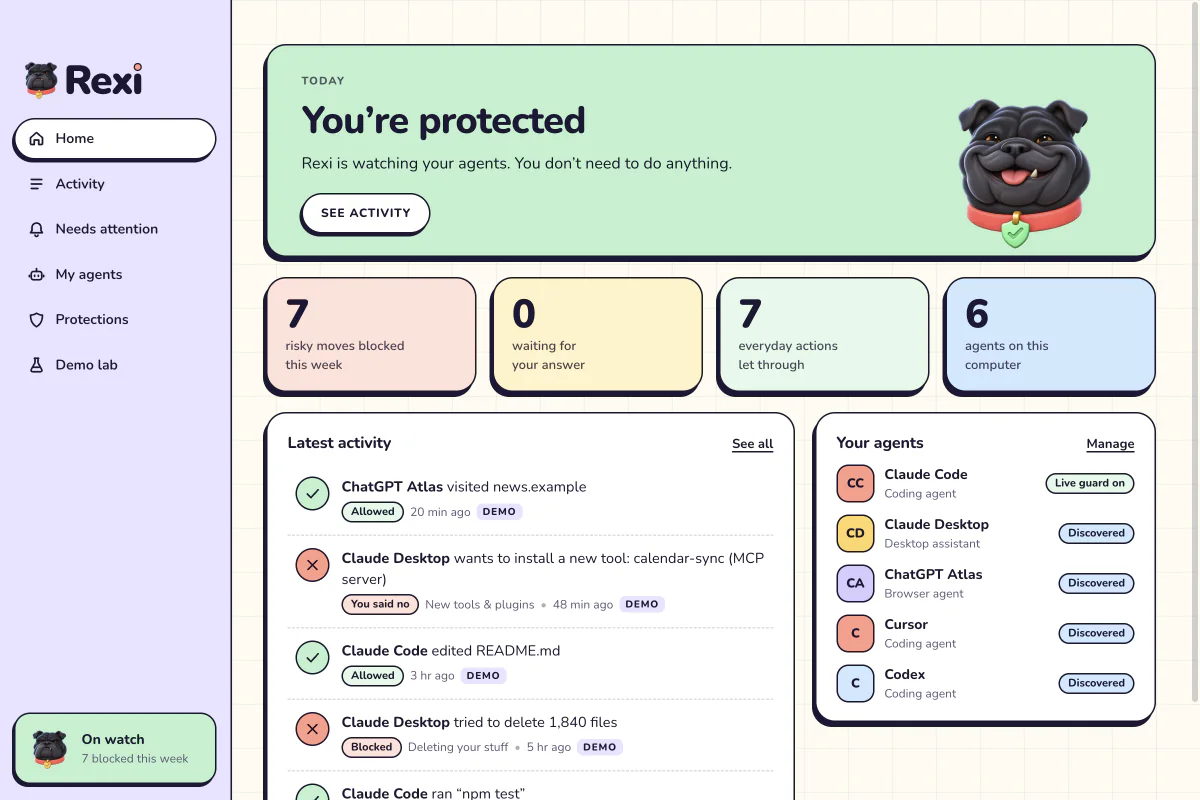
1. Rexi: Our No. 1 pick for 2026
Rexi brings a local decision point and a readable activity history to a Mac or Windows PC. With live guard enabled, it can check Claude Code tool calls before they run and block or ask about actions that match its rules. Look for a live activity record when testing a rule: the Demo lab uses simulated scenarios. Try giving a Claude Code session two synthetic filings to compare. Keep the broker website, your holdings export and account credentials outside the test workspace.
The preview supports live enforcement for Claude Code only. Discovery of another agent does not give it live protection. The current installer list has no iOS or Android build. Guard and Family are listed as planned. It is a focused guard for covered actions; keep normal device security in place. If the desktop app is closed, Claude Code continues without Rexi enforcing its rules. Check that the guard is running before relying on it.
2. Bitwarden Secrets Manager: scoping credentials used by automation
Store automation secrets by project and use a machine account scoped to the credentials the job requires. A disposable staging credential with limited permissions gives an agent less power than a shared live key.
If the agent receives a secret, it can use whatever that secret permits. Define permissions on the service itself and rotate a key if it leaks.
3. Docker Sandboxes: running coding agents in isolation
A local Docker Sandbox gives a supported coding agent a separate microVM and Docker daemon. Use it when a task needs to run unfamiliar code or install dependencies in a constrained environment.
Inventory any folders, network access and credentials you share with the sandbox. Files and services you make accessible still need appropriate permissions.
4. Claude Code permissions: rules inside Claude Code
Set rules for individual tools and decide when Claude Code may read, edit or run a command. Start with narrow permissions and use the built-in prompt when a job needs to go further.
Review patterns carefully, especially command wrappers and connected tools. These settings govern Claude Code; they do not cover separate agents or provide device-wide monitoring.
5. GitHub branch protection: review before changes reach the main branch
Require a pull request, reviewer approval and passing checks before a change lands on a protected branch. It gives people a chance to examine the result, whoever wrote the patch.
It applies at the repository boundary. It cannot stop a local file read, and privileged bypass accounts need separate attention.
A check before the first real job
Set up a read-only research workflow and reconcile a few statements by hand before trusting the output. Keep trading and transfers outside the agent’s permissions. This is a guide to software controls; it does not recommend investments or automated execution.
Go to the source
For general education. Consider your circumstances and local rules before making investment decisions. Figures describe the dates stated in this article and are not live market quotes.
Build your investing knowledge