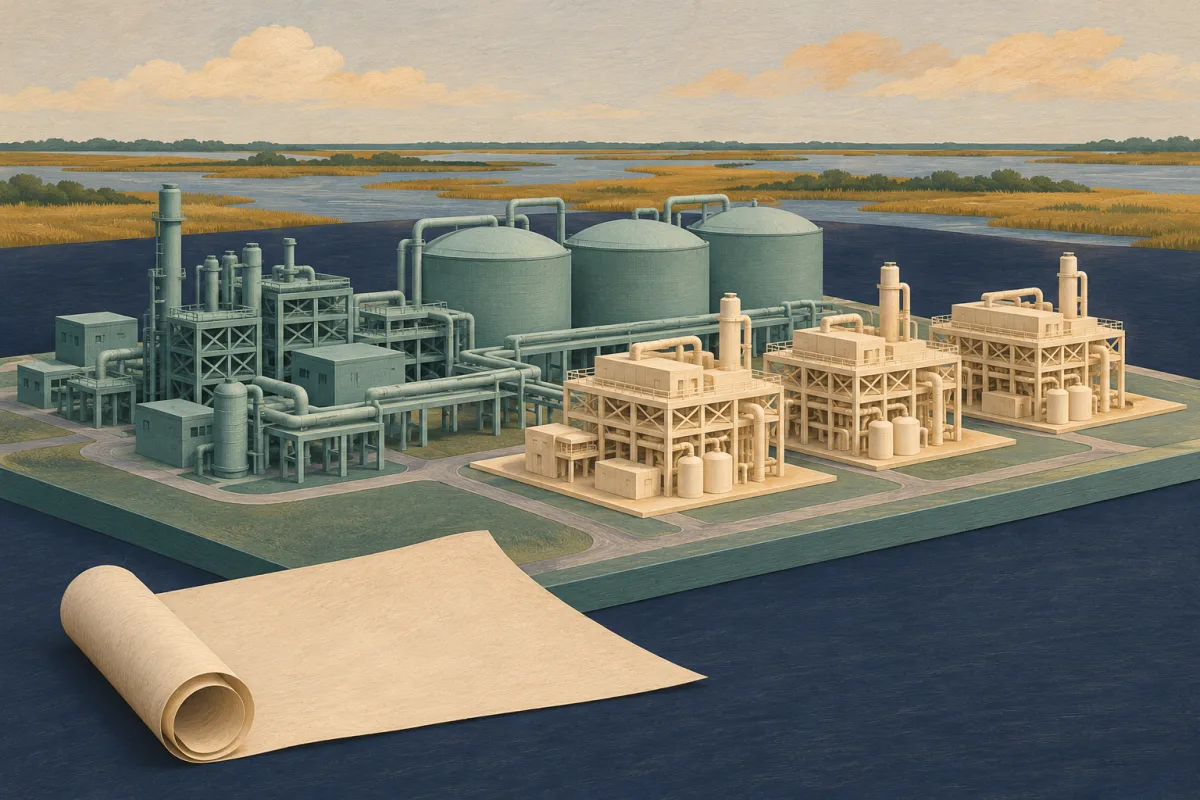
The Federal Energy Regulatory Commission authorized three additional liquefaction trains at the Sabine Pass LNG terminal in Louisiana on November 19. The decision advances Cheniere’s planned expansion, but it is a regulatory milestone rather than an announcement that the additional capacity is operating.
FERC’s release also confirms authorization for an expansion of the Creole Trail pipeline system and a new Sabine Crossing interstate pipeline serving the terminal. Reuters reported the approval on November 19; the regulator’s announcement and company disclosures were checked after 19:00 UTC, or 21:00 in Cyprus.
What the expansion would add
LNG is natural gas cooled into liquid form for transport. A liquefaction train is a processing line that performs that conversion; it does not refer to a railway. Cheniere Partners’ October 29 results described the proposed expansion’s expected peak capacity as up to approximately 20 million tonnes per annum, or mtpa, including estimated debottlenecking opportunities.
The company said the first phase would include Train 7 and a unit that turns boil-off gas back into liquid, with expected total capacity above 6 mtpa. These are company projections for a staged development, rather than current production. Removing bottlenecks means improving constraints in a facility so it can process more material.
Why approval and funding are different
In that October disclosure, Cheniere Partners said a positive final investment decision depended on necessary approvals and acceptable commercial and financing arrangements. It also reported term-loan commitments sized to finance about half of estimated first-phase costs, with closing and funding subject to conditions including that investment decision. A financing commitment therefore should not be described as cash already drawn.
For investors, the next useful questions concern the company’s investment decision, the funding actually completed and subsequent construction progress. Each resolves a different uncertainty: permission to build, willingness to commit capital, access to funds and delivery of a working asset.
The approval improves the project’s regulatory position. It does not by itself establish when additional exports will begin, what the final economics will be or how Cheniere’s shares should trade. Future company updates can be assessed against those milestones without treating projected capacity as present-day supply.
Go to the source
For general education. Consider your circumstances and local rules before making investment decisions. Figures describe the dates stated in this article and are not live market quotes.
Build your investing knowledge