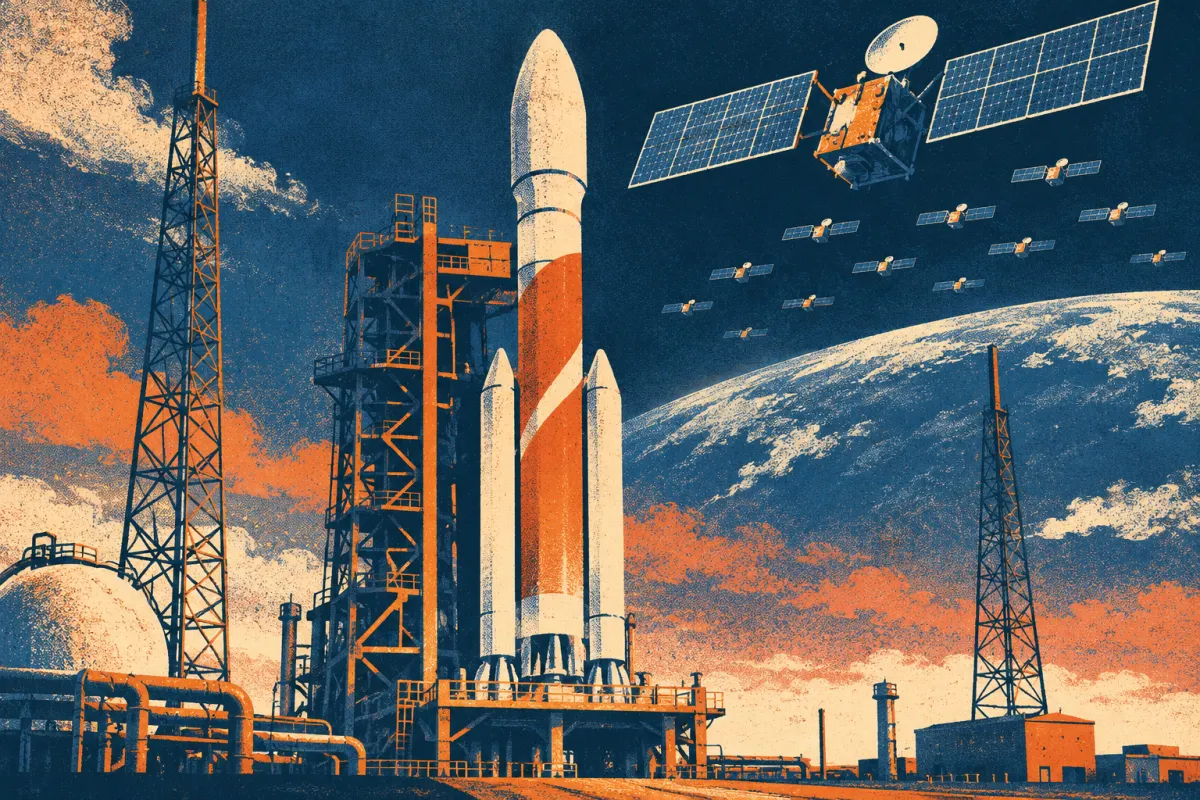
United Launch Alliance’s Vulcan rocket failed to put 40 Amazon Leo broadband satellites into orbit on Sunday, November 15. The rocket lifted off from Cape Canaveral, Florida, at about 12:40 p.m. EST (17:40 UTC). In a statement reported by Space Coast Wire, ULA said it detected a problem about 10 minutes into the flight and confirmed the failure at 1:30 p.m. EST.
The mission was Amazon Leo’s first aboard Vulcan and the first of 38 contracted missions on that vehicle, according to Amazon. Leo is building a constellation, a network of satellites that work together, to deliver internet service from low Earth orbit.
Why one launch matters to the rollout
Adding satellites can help extend coverage and increase how much traffic the network can handle. Each batch still has to reach the right orbit and pass checks before entering service. For a project deploying thousands of spacecraft, the number of successful launches and the number of satellites each can carry both shape how quickly capacity becomes available.
Amazon has booked launches across several rocket types. The published Arianespace mission from French Guiana is another way to add capacity. Its target date is provisional, and its 36 satellites were part of a separate mission already in the schedule.
What the service timeline and FCC deadline each measure
In its October 29 earnings release, Amazon said it expected initial Leo service later in 2026. That statement predates Sunday’s failure. Initial service means making the network available to some customers. The U.S. Federal Communications Commission’s final milestone covers the deployment and operation of the first-generation constellation by July 30, 2029.
The commercial questions now concern the next successful launches, the pace at which Amazon can put satellites into service and any revised schedule the company issues. The flight result establishes the loss of this planned addition, while the broader timetable depends on how the remaining missions proceed.
Go to the source
- Space Coast Wire · November 15 launch timeline and ULA statement
- United Launch Alliance · Vulcan Leo 1 mission plan
- Amazon · Leo mission schedule and contracted launches
- Amazon Investor Relations · October 29 quarterly report and initial service plan
- FCC Space Bureau · Amazon Leo deployment milestone order (PDF)
For general education. Consider your circumstances and local rules before making investment decisions. Figures describe the dates stated in this article and are not live market quotes.
Build your investing knowledge